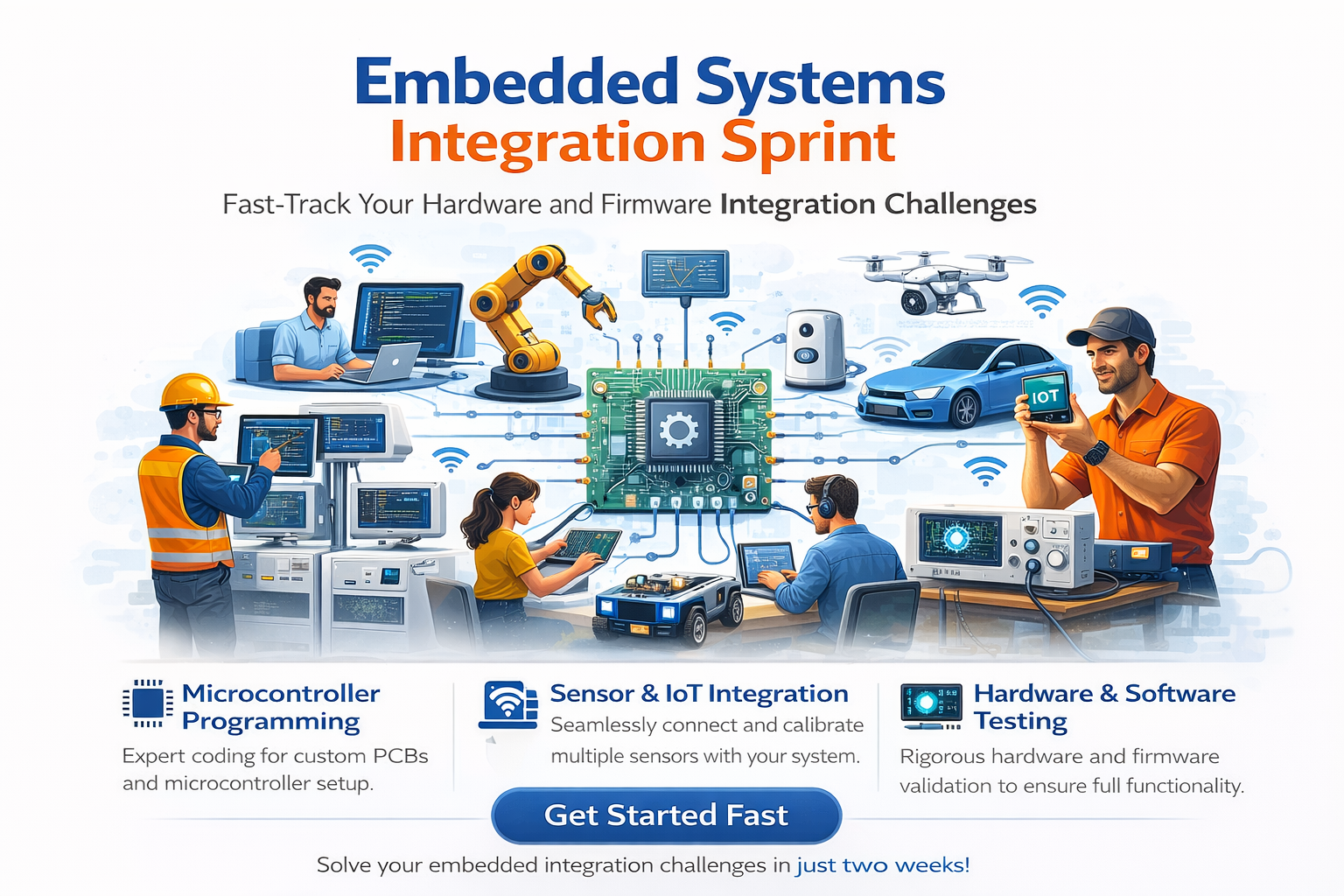
Embedded Systems Integration Sprint
$0.00
A focused 2-week embedded firmware sprint to integrate, debug, and optimize your existing hardware—turning your PCB, sensors, or display into a fully working system.
Description
This sprint is ideal for:
-
Companies with custom PCBs that power on but don’t fully work
-
Teams stuck integrating displays, sensors, or peripherals
-
Startups needing quick technical validation before scaling
-
Industrial or IoT products needing firmware tuning and optimization
If your hardware already exists but firmware integration is blocking progress, this sprint removes that bottleneck—fast.
This is a time-boxed, fixed-scope engagement focused on one clearly defined integration challenge.
No open-ended development. No long contracts.
1. Display & Touch Driver Integration
Use Case: Custom LCD, touchscreen, or HMI not working reliably.
Includes:
-
Display driver bring-up and configuration
-
Touch controller integration and calibration
-
Framebuffer / graphics pipeline validation
Supported Platforms:
-
Embedded Linux
-
ESP32
-
RP2040
📦 Deliverable:
-
Fully functional display & touch interface
-
Working demo application
-
Driver configuration and integration notes
2. Multi-Sensor Fusion Prototype
Use Case: Multiple sensors working individually but not together.
Includes:
-
Integration of 2–4 sensors (IMU, environmental, proximity, etc.)
-
Sensor calibration and validation
-
Data fusion logic (basic filtering/aggregation)
-
Telemetry or logging output
📦 Deliverable:
-
Sensor fusion firmware prototype
-
Live data output (UART / file / network)
-
Calibration parameters and test results
3. Low-Power Optimization Audit
Use Case: Battery life is lower than expected.
Includes:
-
Power profiling and bottleneck identification
-
Sleep mode and peripheral optimization
-
Firmware refactoring for energy efficiency
📦 Deliverable:
-
Optimized firmware build
-
Power usage comparison report (before vs after)
-
Actionable recommendations for further gains
Timeline (Time-Bound Delivery)
⏱ 2 Weeks Total
-
Week 1: Setup, analysis, and initial integration
-
Week 2: Debugging, validation, optimization, and handover
No extensions. No uncertainty.