Ignition Nexus™ – IT–OT Integration Architecture for Ignition SCADA Platform
$0.00
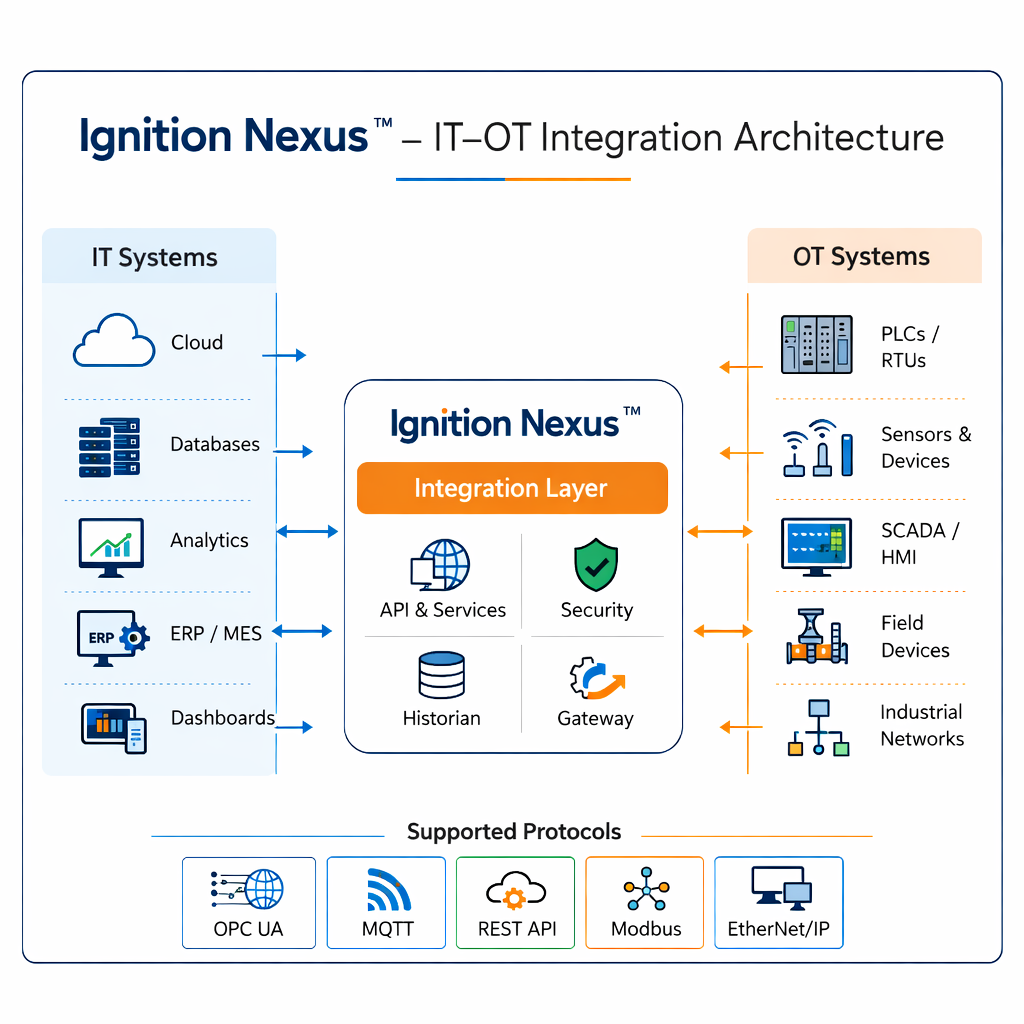
The IT–OT Integration Architecture for Ignition SCADA Platform provides a structured framework for securely connecting Operational Technology (OT) environments such as PLCs, RTUs, and industrial control systems with enterprise Information Technology (IT) systems including cloud services, enterprise databases, analytics platforms, and business applications.
The architecture leverages Ignition SCADA’s modular platform to enable standardized data exchange, real-time monitoring, secure API connectivity, and scalable industrial data pipelines, supporting digital transformation, Industry 4.0 initiatives, and enterprise-level operational intelligence.
Description
The IT–OT Integration Architecture for Ignition SCADA Platform is designed to bridge the traditional separation between industrial control systems and enterprise IT infrastructure. Modern industrial operations increasingly require seamless data exchange between plant-floor automation systems and enterprise software platforms such as ERP, MES, cloud analytics, asset management systems, and AI-driven optimization tools.
This architecture uses the Ignition SCADA platform as a central integration hub, providing standardized mechanisms for secure communication, data normalization, and scalable system integration across heterogeneous environments.
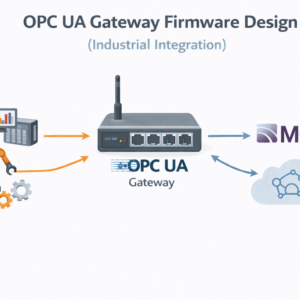
The architecture supports communication with a wide range of industrial devices including PLCs, RTUs, field instrumentation, and industrial gateways through industrial protocols such as OPC UA, Modbus TCP, MQTT, EtherNet/IP, and other supported drivers. These protocols allow reliable acquisition of operational data from production equipment, energy systems, utilities infrastructure, and process control environments.
Within the OT layer, Ignition collects and contextualizes real-time data streams from distributed industrial assets. The platform provides centralized tag management, historian services, alarm management, and visualization capabilities that enable operators and engineers to monitor and control industrial processes through web-based HMIs and dashboards.
At the integration layer, Ignition acts as a middleware gateway that enables controlled data exchange between OT systems and IT services. Through its REST API interfaces, scripting capabilities, and database connectors, the platform can publish operational data to enterprise applications, business intelligence systems, machine learning pipelines, and cloud services.
This integration layer allows organizations to implement advanced operational use cases including predictive maintenance, real-time asset monitoring, energy optimization, remote operations, and digital twin simulations.
Security is a fundamental design principle within the IT–OT integration architecture. The system implements multiple layers of cybersecurity protection including role-based access control, secure authentication mechanisms, encrypted communications using TLS, network segmentation between IT and OT zones, and compliance with industrial cybersecurity frameworks such as IEC 62443 and NIST cybersecurity guidelines.
The architecture also supports high availability and scalability through redundant gateway configurations, distributed system deployment, and load balancing capabilities. This ensures that critical industrial operations remain reliable even in large-scale enterprise environments with thousands of connected devices and millions of real-time data points.
From a data management perspective, the architecture provides structured storage of industrial data through integrated historians and enterprise databases. Time-series process data can be stored for long-term analytics while event-driven data streams can feed operational dashboards and automated decision systems.
The IT–OT Integration Architecture is particularly suited for sectors such as energy generation, renewable power plants, battery energy storage systems (BESS), manufacturing, oil and gas, water utilities, and smart infrastructure, where real-time operational intelligence must be integrated with enterprise business processes.
Overall, the architecture enables organizations to transform isolated industrial control environments into connected digital ecosystems, unlocking the full value of industrial data while maintaining strict safety, reliability, and cybersecurity standards.