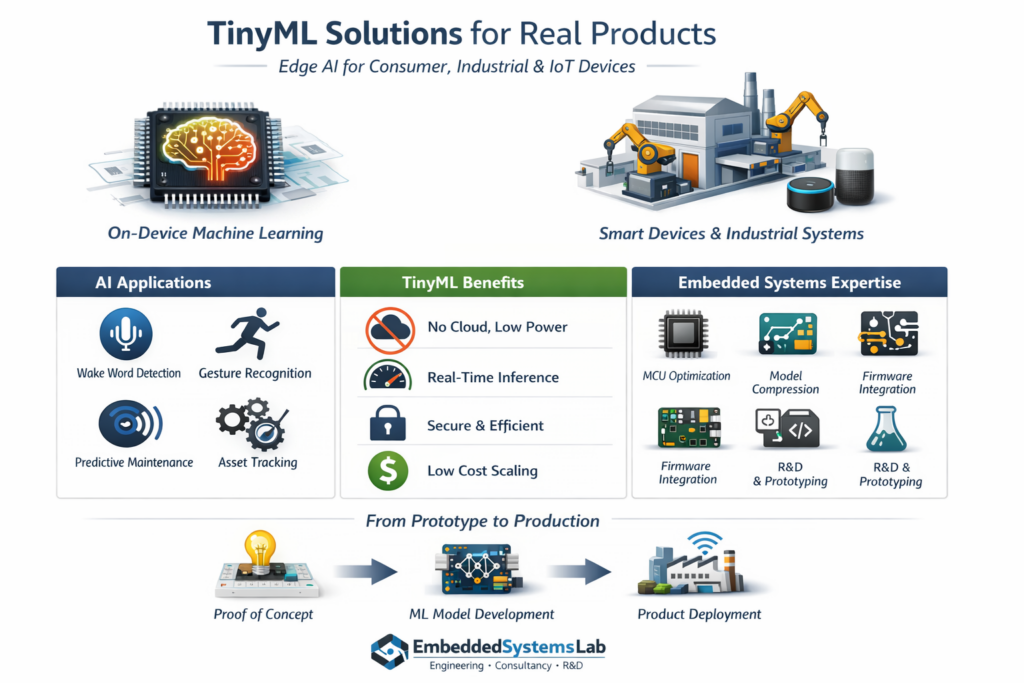
TinyML enables machine learning to run directly on microcontrollers—without the cloud, without GPUs, and without ongoing data costs.
For founders building commercial, consumer, or industrial products, this changes what’s possible at scale.
At Embedded Systems Lab, we help teams move TinyML from demo to deployable product—reliably, securely, and within real-world constraints.
Why TinyML Matters for Product Founders
If your product involves sensors, patterns, or decisions at the edge, TinyML may be the difference between a viable business and a fragile prototype.
TinyML allows you to:
- Run AI offline (no cloud dependency)
- Reduce latency from seconds to milliseconds
- Lower power consumption for battery-powered products
- Protect IP & user data by keeping inference on-device
- Scale economically without per-device cloud costs
This makes it ideal for mass-produced embedded products, not just research demos.
Where TinyML Is Already Winning
We see TinyML deployed successfully in:
Consumer Products
- Wake-word detection
- Gesture recognition
- Smart appliances
- Wearables & health monitors
Industrial Systems
- Predictive maintenance
- Motor and vibration analysis
- Anomaly detection on sensors
- Condition-based monitoring
Commercial & IoT Devices
- Smart meters
- Asset tracking
- Environmental monitoring
- Low-power edge analytics
If your product uses ESP32, ARM Cortex-M, RISC-V, or similar MCUs, TinyML is already within reach.
The Reality Check: TinyML Is Not “Drop-in AI”
Most TinyML projects fail not because of ML—but because of embedded constraints.
Common pitfalls we see:
- Models that don’t fit memory
- Power consumption exploding in production
- Poor sensor data pipelines
- Latency breaking real-time requirements
- ML models trained without hardware awareness
- Firmware and ML teams working in silos
TinyML is a system engineering problem, not just a model-training exercise.
How Embedded Systems Lab Helps
We support TinyML projects end-to-end, from idea validation to production readiness.
Engineering & Implementation
- MCU and hardware selection for TinyML
- Sensor data pipeline design
- Model optimization (quantization, pruning)
- Firmware + ML integration
- Real-time and low-power optimization
Consultancy & Architecture
- Is TinyML the right approach for your product?
- On-device vs cloud tradeoff analysis
- BOM, power, and performance feasibility
- Scaling considerations for mass production
R&D & Prototyping
- Proof-of-concept builds
- Dataset strategy and feature extraction
- Edge AI experimentation
- Production readiness assessment
Our focus is commercial viability, not academic benchmarks.
When You Should Talk to Us
Reach out if:
- You’re evaluating TinyML vs cloud AI
- You have a working prototype that needs to scale
- Your ML model works—but not on real hardware
- Power, latency, or cost is blocking launch
- You need a trusted embedded + ML engineering partner
We work with founders, startups, and product teams who want real products—not demos.
Build TinyML That Ships
TinyML is no longer experimental—but shipping it correctly requires deep embedded systems expertise.
If you’re serious about launching a TinyML-powered product,
let’s talk before costly mistakes are baked into hardware.
👉 Contact us to discuss engineering services, consultancy, or R&D support for your TinyML product.

