When entrepreneurs think about launching a hardware product, the focus is often on industrial design, BOM cost, or cloud dashboards. But in real-world commercial, consumer, and industrial products, firmware architecture is what determines whether a device scales—or quietly fails after the first batch.
At Embedded Systems Lab, we treat firmware not as “code that runs on a chip,” but as a long-term product asset.
Why Firmware Architecture Matters from Day One
Poorly structured firmware works until it doesn’t:
- Features become expensive to add
- Debugging takes longer than development
- Field updates become risky
- Hardware revisions break software unexpectedly
A well-designed firmware architecture, on the other hand:
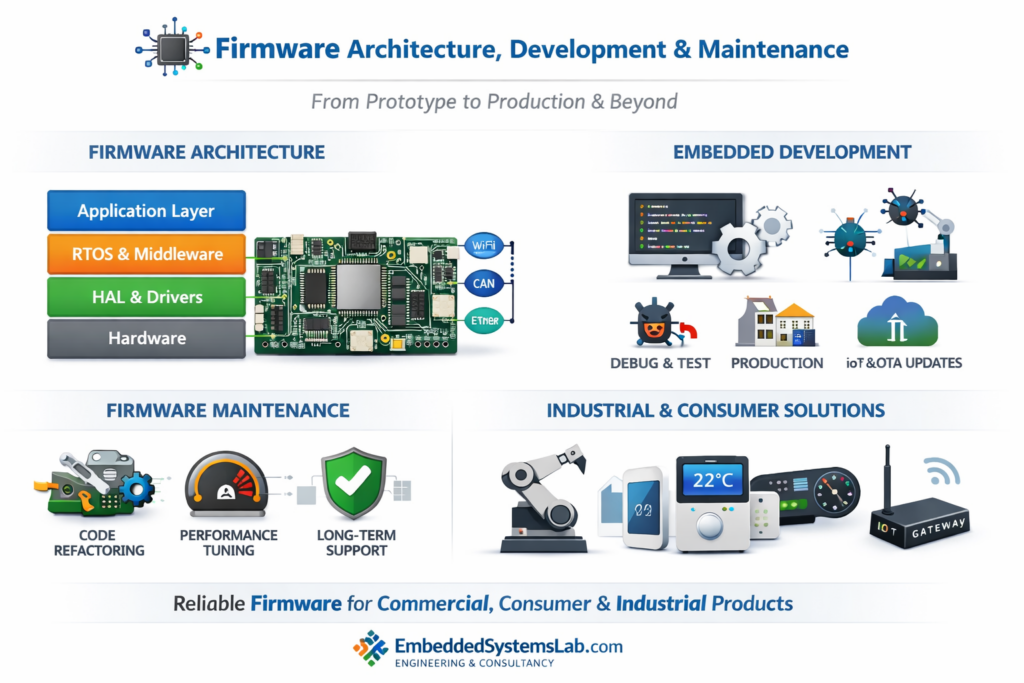
- Separates hardware, logic, and communication cleanly
- Survives component changes and silicon revisions
- Scales from prototype → pilot → mass production
- Enables predictable certification, testing, and OTA updates
This is especially critical for ESP32-class devices, industrial controllers, gateways, battery-powered products, and connected edge systems.
Our Approach to Firmware Development
We build firmware the same way mature product companies do:
1. Architecture First
Before writing features, we define:
- Hardware abstraction layers (HAL)
- RTOS task models and scheduling
- Communication boundaries (BLE, Wi-Fi, Ethernet, CAN, Modbus, OPC UA, MQTT, HTTP)
- Memory, power, and failure-mode strategies
2. Production-Grade Development
Our firmware development focuses on:
- Deterministic behavior (not “it usually works”)
- Clear module ownership and interfaces
- Versioned APIs between firmware components
- Testability and traceability for future compliance
3. Real-World Constraints
We design for:
- Brown-outs, EMI, and power instability
- Field firmware updates and rollback safety
- Manufacturing test hooks
- Long-term maintainability by future teams
RTOS Architecture
Most embedded developers can create RTOS tasks. Our firmware architects design RTOS systems — the difference matters at scale.
We work with FreeRTOS, Zephyr, and ThreadX across:
- Task prioritisation, preemption, and deadline analysis
- Interrupt service routine (ISR) design and deferred processing patterns
- Mutex, semaphore, and event group design for race-condition-free systems
- Stack usage profiling and memory footprint optimisation
- Tick-less idle modes for power-constrained devices
We also handle bare-metal scheduling where RTOS overhead is not acceptable — deterministic ISR chains, cooperative state machines, and superloop architectures.
Communication Protocol Depth
We work at the driver level across the full embedded protocol stack — not just application-layer integration. Our protocol work spans:
- Synchronous bus protocols: SPI (single/dual/quad), I2C (standard, fast, fast+), I3C
- Asynchronous serial: UART, RS-232, RS-422, RS-485, MODBUS RTU/ASCII
- Field bus / industrial: CAN 2.0A/2.0B, CANopen, EtherCAT, Modbus TCP, OPC-UA
- Network layer: Ethernet (LwIP, raw sockets), MQTT, HTTP/HTTPS, TLS 1.2/1.3
- Wireless: BLE (GATT/GAP), Wi-Fi (STA/AP/Mesh), LoRa, Zigbee
We write, validate, and debug at the register level — not just configure middleware.
Hardware Bring-Up and Low-Level Debug
Firmware confidence starts at the bench, not the IDE.
We support hardware bring-up from blank PCB to running firmware — including:
- JTAG/SWD debug setup and trace configuration (J-Link, OpenOCD, pyOCD)
- Peripheral validation with oscilloscopes and logic analyzers
- Register-level peripheral bring-up (timers, ADC, DMA, clocks)
- Schematic review for firmware-hardware interface issues
- Signal integrity checks on high-speed bus lines (SPI, CAN, Ethernet PHY)
This matters most when a vendor’s BSP doesn’t match your silicon revision — and it almost never does.
Firmware Testing Infrastructure — HIL, SIL, and CI/CD
Shipping firmware without a test strategy is shipping technical debt.
We design and implement:
- Hardware-in-the-Loop (HIL) test rigs that validate firmware against real peripherals automatically
- Software-in-the-Loop (SIL) environments for logic validation without hardware dependency
- Automated regression suites using pytest or Robot Framework, integrated into CI/CD pipelines
- Manufacturing test hooks — factory test modes baked into firmware for production line validation
- OTA update validation — rollback safety, image integrity checks, fail-safe boot sequences
The goal: every firmware release is testable, traceable, and auditable — not just “seems to work.”
Platform Experience — MCUs We’ve Worked On
We are platform-agnostic but not platform-naive. Our hands-on experience covers:
| Family | Specific Parts |
|---|---|
| STMicroelectronics | STM32F4, STM32G0/G4, STM32H7, STM32WB |
| Espressif | ESP32, ESP32-S3, ESP32-C3 (BLE/Wi-Fi class) |
| NXP | LPC55, i.MX RT series |
| Microchip / PIC | PIC32MZ, PIC32MX, SAM series |
| Texas Instruments | TMS320, MSP430, MSPM0 |
| Nordic Semiconductor | nRF52 series (BLE-centric) |
Platform selection advice is included in all architecture engagements.
Our Firmware Language & Toolchain Stack
- Primary languages: C (C99/C11), C++ (C++14/17 for embedded)
- Tooling & scripting: Python (pytest, automation, build scripts)
- Emerging: Rust for safety-critical and high-reliability targets
- Build systems: CMake, Make, West (Zephyr), MPLAB Harmony
- Version control & CI: Git, GitHub Actions, GitLab CI with embedded runners
Who This Is For
We also partner directly with engineering teams who need:
- A senior firmware architect for a fixed-scope design review
- Surge capacity on a specific MCU platform their team doesn’t know
- An independent technical audit before a product certification (IEC 62443, IEC 61508, FCC/CE)
- A second opinion on an unstable codebase before it ships
Certifications & Compliance-Ready Firmware
For products targeting regulated markets, we design firmware with compliance in mind from the start — not retrofitted at the end. This includes traceability matrices, MISRA-C compliance checks, functional safety partitioning, and documentation artefacts aligned with IEC 62443 (industrial security), IEC 61508 (functional safety), and FDA embedded software guidance.
Firmware Maintenance Is Where Products Win or Lose
Most products fail after launch, not before it.
We help teams with:
- Firmware refactoring of legacy or prototype code
- Stability and crash-root-cause analysis
- Power, memory, and performance optimization
- Hardware revision compatibility
- Long-term firmware ownership transfer
Whether your device will ship 1,000 or 1,000,000 units, firmware maintenance must be planned—not improvised.
Who This Is For
Our firmware services are ideal if you are:
- Launching a commercial, consumer, or industrial product
- Transitioning from prototype to production
- Struggling with unstable firmware or feature creep
- Planning certifications, OTA updates, or scaling manufacturing
- Lacking in-house embedded firmware architecture expertise
How We Work With You
You can engage us as:
- Firmware architects (design reviews & system planning)
- Hands-on engineers (development, optimization, integration)
- Technical consultants (risk reduction, audits, roadmap definition)
- R&D partners for advanced or experimental systems
Our services are delivered as clearly scoped, outcome-driven engagements—not open-ended hourly work.
-
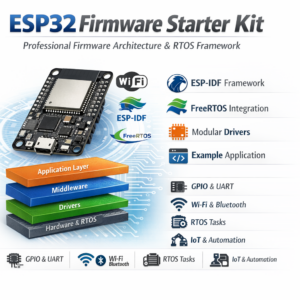
ESP32 Firmware Starter Kit — Professional Firmware Architecture & RTOS Framework
$1,200.00 Add to cart -
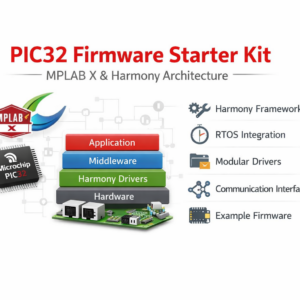
PIC32 Firmware Starter Kit — MPLAB X & Harmony Architecture
$1,200.00 Add to cart -
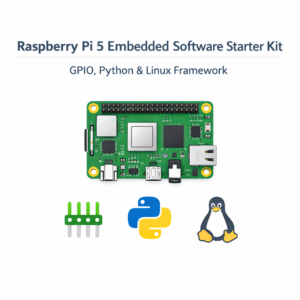
Raspberry Pi 5 Embedded Software Starter Kit — GPIO, Python & Linux Framework
$1,200.00 Add to cart -
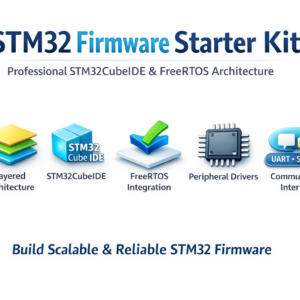
STM32 Firmware Starter Kit — Professional STM32CubeIDE & FreeRTOS Architecture
$1,200.00 Add to cart
Ready to Build Firmware That Scales?
If your product depends on reliable, maintainable, and production-ready firmware, we can help you design it right—before technical debt becomes your biggest cost.

